<< Back to Index << << Previous - Ancient Greece << >> Next - Rainbows >>
The
Accidental Surgeon
by Dr Louise
Chambers
When I first
began compiling an archive regarding the emergence of ‘gender reassignment
surgery’, I never imagined that my research would take me back as far as the 1830s.
According to
Elizabeth Reis (2009: 45-6), one of the first descriptions of genital surgery
occurs in notes made by one Dr John C. Warren, a surgeon at Harvard and one of
the founders of the Massachusetts General Hospital in Boston. Warren’s patient,
a 23 year-old woman, appeared to have ‘no vagina’, although she did have
‘normal breasts’ and a clitoris. Warren made an incision at the front of the
woman’s rectum and created a vaginal opening ‘three inches deep’ which, after
‘days of profuse bleeding, fever and pain’ (and a period of dilation), seemed
to remain open after the wound had healed (ibid., 46).
Reis argued
that the main motivation for this kind of intervention was to ensure that the
person concerned had ‘normal’ and natural (ie. heterosexual) sexual relations.
Consequently, many of the early reports on genital surgery tended to appear in
marriage manuals, as well as the usual journals on medical science.
This point
is echoed by writers like Alice Dreger (1998) and Suzanne Kessler (1998), who
argue that the sudden ‘appearance’ of, and moral panic around, the
‘hermaphrodite’ was as much to do with fears about same sex relations as it was
to do with ensuring individuals had a happy, (re)productive life.
So what does
this all have to do with trans people? Well, it is my belief that the emergence
of surgical interventions as a means of ‘curing’ what became known as ‘Gender
Identity Disorder’ or ‘Gender Dysphoria’ occurred at the juxtaposition of three
nineteenth century ‘discoveries’: the hermaphrodite, the invert and the concept
of psychical hermaphroditism. I would like to examine each of these in turn.
The
Hermaphrodite
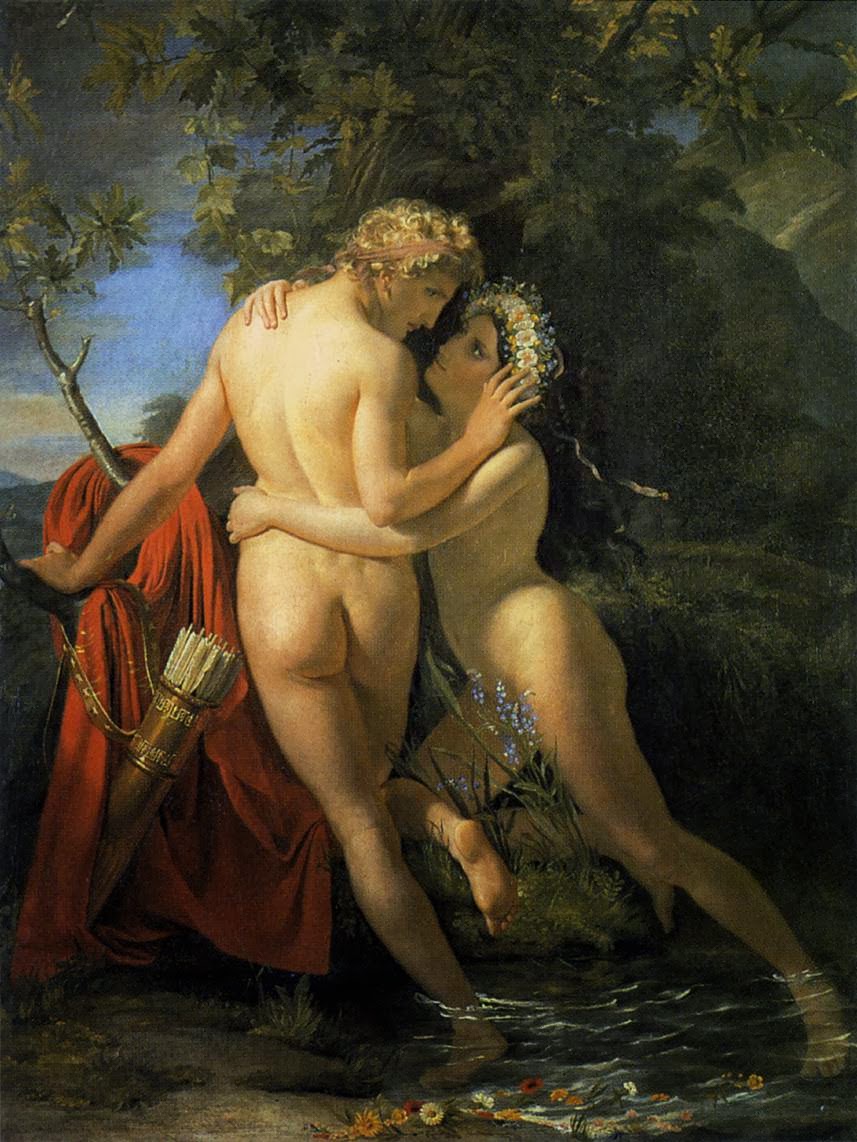 |
The Nymph Salmacis & Hermaphroditus by François-
Joseph Navez, 1829; Museum of Fine Arts, Ghent |
For those
readers not so well versed in Greek mythology, a short interlude…
According to
Ovid (Metamorphoses Book IV) Hermaphroditus was the son of the gods Hermes and
Aphrodite and, when he was 15, he found himself wandering near a pool wherein
lived a nymph by the name of Salmacis. Now, being the son of Aphrodite,
Hermaphroditus was of course very beautiful and, after stripping off his
clothes and diving into the pool, Salmacis fell in love with him. Unfortunately
her affections were not returned and, as she clung to his body, Salmacis prayed
they could be joined as one. The gods heard her prayers and joined them
together – literally:
Her prayers
find propitious Deities, for the mingled bodies of the two are united, and one
human shape is put upon them…So, when their bodies meet together in the firm
embrace, they are no more two, and their form is twofold, so that they can
neither be styled woman nor boy; they seem to be neither and both. (Ovid,
Metamorphoses, IV. 376-391)
Now,
strictly speaking, this account suggests that an hermaphrodite is both male and
female and has both sets of reproductive organs: this is certainly the
definition commonly used today. Nonetheless, the Victorian physicians and
surgeons seemed to conveniently ignore that idea and broadened the category to
include pretty much anyone who presented genital or gonadal differences that
would be classified as ‘ambiguous’ or ‘atypical’ in the determination of an
individual’s sex (and, by extension, their sexual orientation). There is a
paradox here, however: despite the hermaphrodite sobriquet, most physicians
insisted that the individuals who presented with ‘atypical genitalia’ were not
part man and part woman. As Dr JW Long (1896: 243) commented:
"the
peculiarities which make them appear mixed, are only deformities… they always,
with scarce an exception, belong to either one sex or the other."
Dreger
(1998: 153-4) suggests that this paradox was resolved through the virtual
elimination of the ‘true’ hermaphrodite – a move which may have been partly due
to the fear that the possibility of sexual dimorphism among humans fed the
continuing paranoia about legitimising same sex couples. This may also explain
the emergence of the categories of male and female pseudohermaphroditism – a
category to which we will return later in this essay.
Whilst Reis
lists a number of early accounts of surgical interventions in the first half of
the 19th century, the philosopher and historian Michel Foucault (1980: ix)
argued that matters really came to a head (accompanied by the ensuing moral
panic) in 1860, following the publication of an autobiography by one Herculine
Barbin:
“The years
from around 1860 to 1870 were precisely one of those periods when
investigations of sexual identity were carried out with the most intensity, in
an attempt not only to establish the true sex of the hermaphrodites but also to
identify, classify and characterise the different types of perversions.”
Barbin’s
story was first published in 1860. Barbin was sexed as a female on her birth in
1838 but, when examined by a doctor at the age of 22 after complaining of
severe pains in her groin, the examining doctor reported that Herculine had a
larger than average clitoris and – crucially for the times that Dreger (1998)
has described as ‘The Age of the Gonads’ – testicles in a ‘divided scrotum’.
She also had a vagina, but neither this, nor her clitoris, prevented the
examining doctor from declaring, on finding her ‘testes’:
“These are
the real proofs of sex. We can now conclude and say: Alexina is a man,
hermaphroditic, no doubt, but with an obvious predominance of masculine sexual
characteristics.”
It’s worth
noting that Alexina/Herculine made no secret of her desire for other women – in
fact her memoir celebrated the fact that, once declared a ‘man’, she would be
able to marry her lover, Sara. Unfortunately, things did not work out that way
and, eventually, Herculine took her own life, shortly after completing her
memoirs.
Alice Dreger
(1998) argued that the late 19th century witnessed a veritable explosion of
human hermaphrodites – a phenomenon that might be partly to do with Barbin’s
revelations, but may also be accounted for in the rise of the medical and gynaecological
sciences in the second half of the 18th century and the simple fact that,
post-Barbin, physicians were on the ‘look out’ for other instances of
‘hermaphroditism’. It was clear that, during this period, people with
‘atypical’ or reproductive systems were always already constituted as a
‘problem’. Dreger (1998: 34) noted that the French anatomist, Isidore Geoffroy
Saint- Hilaire (1805-1861) created a new field which he called teratology (the
biological study of malformations and ‘monstrosities’) and hermaphrodites were
included in that field:
“by the
early 19th century, hermaphroditism was understood by scientists and medical
men as a phenomenon to be fully explained by the natural sciences, one existing
within the realm of natural law.”
When reading
through the different accounts of surgical interventions, the main motivation
for the surgery seems to be the production of a person with heteronormative
desires. As Reis (2009: 56) observed:
"To
uncover the history of intersex is to expose the consequences of pervasive
attitudes toward permissible and impermissible sexuality… Physicians
uncritically accepted and acted on their own heterosexual norms, often
elevating marriage as a goal to parents considering surgery for their
children." P.56
This conflation
of hermaphroditism and homosexuality was only possible, I would argue, due to
the way in which a slightly obscure theory of same sex desire, proposed by one
Karl Heinrich Ulrich, was transformed by the Viennese psychiatrist, Richard von
Krafft-Ebing, into what became known as a theory of sexual inversion.
anima
muliebris in corpore virili inclusa
(a feminine
‘essence’ incorporated in a male body) (1)

I don’t have
time to discuss Ulrichs’ life in detail here (2), but would sketch out a couple
of important points. Ulrichs was open about his love for other men and, when
the opportunity came to challenge §143 of the Prussian criminal code (which
criminalised sex between men), Ulrichs realised that the committee considering
a change to the law would require any challenge to be supported by scientific
proof. For Ulrichs, the existence of sexual dimorphism offered that proof. The
classification of hermaphroditism as a ‘naturally-occurring’ phenomenon was a
significant factor in the development of Ulrichs’ theories of sexuality and the
next logical move was to hypothesise a shift from a wholly physical form of
hermaphroditism, to a model of hermaphroditism where one aspect of the sexed
body is material and the other is immaterial. Effectively, Ulrichs posited the
existence of a ‘third sex’, the Uranier, (3) which was naturally dimorphic and
thus could be thought of as a “uranian hermaphrodite”. In 1863, Ulrichs wrote
and published two pamphlets: Inclusa, which set out Ulrichs’ theory of
dimorphism, and Vindex, where Ulrichs set out empirical evidence for his
theory. Inclusa began with a poem in Latin:
Sunt mihi
barba maris, artus, corpusque virile;
His inclusa
quidem: sed sum maneoque puella.
(Have I a
masculine beard and manly limbs and body;
Yes,
confined by these: but I am and remain a woman.)
Now,
Ulrichs’ efforts to change the Criminal Code failed, but his ideas were to have
unexpected effects. By constituting homoerotic desire as a
pseudo-hermaphroditic condition, Inclusa attracted the attention of the psychiatric
community, and there is evidence of the emergence of a narrative of gender
difference that incorporated disease, morbidity, abnormal pathology and
inversion. Perhaps the most significant development in the emergence of a
narrative of pathology is the relationship that developed between Ulrichs and
Viennese psychiatrist, Richard von Krafft-Ebing. Vindicta included lengthy
quotes from an article written by Krafft-Ebing in 1864. A grateful Krafft-Ebing
responded in a letter to Ulrichs dated 19 January 1879:
I have given
my full attention to the phenomenon, which at that time was just as puzzling to
me as it was interesting; and it was the knowledge of your writings alone,
which gave rise to my research in this highly important field and to the
setting down of my experiences in the essay with which you are acquainted in
the Archiv für Psychiatrie. (Critische Pfeile, 92; my emphasis)
The
psychiatrist Krafft-Ebing transformed Ulrichs’ Romantic, mythological theory of
dimorphism into a more prosaic, Cartesian model of neurological dysfunction. In
Psychopathia Sexualis, the now-famous catalogue of sexual ‘dysfunction’
published in 1886, Krafft-Ebing argued that same sex desire could be explained
through the concept of neurological inversion: sexual desire, originating from
the mind, had somehow become disassociated from the corpus, so that muliebris
in corpore virili inclusa concept was mistranslated and misinterpreted as ‘a
female mind in a male body’ and this epithet was then applied to any and all
individuals who came to Krafft-Ebing’s offices, presenting various aspects of
‘effeminacy’ or sexual desire for other men. The opposite version of the
epithet (‘a male mind in a female body’) would be applied to ‘masculine’ women,
or women expressing desire for other women. Krafft- Ebing (1892: 187) concluded
that an individual’s sexual development can result in an inversion (4) of ‘the
sexual instinct’:
“notwithstanding
a normal anatomical and physiological state of these [genital] organs, a sexual
instinct may be developed which is the exact opposite of that characteristic of
the sex to which the individual belongs.”
 |
| Richard von Krafft-Ebbing |
Krafft-Ebing
(ibid., 222-3) went on to produce a continuum of sexual inversion, including
the concept of psychical hermaphroditism, a concept which, I would argue,
created even more confusion in an already confusing field. Alice Dreger (1998:
128-9) seems to agree. By the beginning of the 20th century, Dreger argues that
the work of sexologists like Krafft- Ebing, Magnus Hirschfeld and Havelock Ellis
had become conflated with theorists of hermaphroditism, and cites an example of
a 1911 presentation by Magnan & Pozzi to the Academy of Medicine in Paris.
The case of a feminine hermaphrodite, with ‘homosexual desires’ was accompanied
by the conclusion that these desires, were “a matter of the brain of a man in
the body of a woman”, ie. “a complete inversion of the genital sense”.
Dreger
argued that many sexologists began to imagine that all cases of inversion were
actually forms of hermaphroditism. No surprise, then, I would argue, that
people began to imagine that surgical interventions, thought as necessary for
the normalisation and ‘well-being’ of hermaphrodites, may also be appropriate
for dealing with inversion. This is particularly true in cases where
homosexuality is ‘suspected’.
An example
is reported by one Dr J Riddle Goffe in 1903 (5): E.C. was a
pseudo-hermaphrodite and, save for a small vaginal opening, had a beard, bushy
eyebrows, no breasts or menstruation and a clitoris, 3 inches long and 3 and a
half inches at its circumference. Goffe decided the clitoris should be removed
and the vaginal opening enlarged, partly because: "She… has been attracted
by boys." The doctor concluded:
"the
sooner… the anatomical features [can be] made to harmonize with the psychic the
better it is for that individual and for society."
The
confusion was exacerbated in 1917 when Richard Goldschmidt, a biomedical
researcher, began using the concept of intersexuality to refer to a range of
gender ‘ambiguities’ that were previously categorised as ‘hermaphroditic’. For
a while this term was also used to refer to homosexuals and inverts. It is
therefore no surprise, when we examine the surgical records at the beginning of
the twentieth century, that the same individuals may be described as
‘hermaphrodite’, ‘intersexual’, ‘pseudohermaphrodite’, ‘invert’ and/or
‘psychical hermaphrodite’. All of which makes it difficult, if not impossible
to claim that so-and-so person is the ‘first example’ of ‘gender reassignment
surgery’. There is, I would argue, no absolute moment that we could point to
and say, “This is when physicians and psychiatrists decided that surgery was
the correct means of disciplining (ie normalising) the body of the
transsexual.” I think this point should be emphasised because I don’t think
there was ever a point when psychiatrists, surgeons and physicians decided that
surgery and hormone therapy were the appropriate treatment for conditions such
as inversion or psychical hermaphroditism. Instead, I want to suggest that the
impetus for corporeal transformation came largely from the individuals
themselves and that part of the reason for this was the development of new
medical technologies, such as plastic surgery and endocrinology.
The
Appliance of Science
At the risk
of oversimplifying matters, I would argue that three co-incidences or
conditions made possible the use of surgery as a ‘cure’ for what would become
known as ‘transsexuality’. I have already discussed two of these conditions:
firstly, the conflation of inversion with hermaphroditism and
pseudohermaphroditism, producing the notion of mind/body dissociation;
secondly, the confusion around terminology, which meant individuals (and their
physicians) might identify their conditions as psychical hermaphrodites or pseudo-hermaphrodites,
seeking surgery as a means of resolving their ‘condition’. The third element is
the development of medical technologies, as plastic surgery, vaginoplasty and
phalloplasty became more sophisticated, and the field of endocrinology emerged
at the beginning of the 20th century.
Bernice
Hausman (1995: 28-9) claimed that Ernest Henry Starling is credited with introducing
the term, ‘hormone’ in 1905; endocrinologists then began to use hormone treatments
for intersex people and these developments led to a confrontation with psychoanalytic
formulations of ‘sexual deviance’. In Glands Regulating Personality, Louis
Berman (1921: 21) wrote: “The future belongs to the biochemist.” Rather grand claims
were made about the effects of artificially-produced oestrogen. For example, Herman
Rubin (1933: 222) asserted:
“It is the
perfect functioning of [the sex] that gives to the woman her charm of
femininity, her rounded contours and soft curves, her pitch of voice, the
comparative absence of hair upon the face, neck and breast.”
The first
decades of the 20th century were also a time of rapid improvements in asepsis and
antisepsis in operating theatres, better surgical dressings, advances in
anaesthesiology, and the use of sulfa drugs and antibiotics. During the Great
War, two surgeons, working independently, developed the ‘tubed pedicle flap’,
used in phalloplasty. The Russian Vladamir Filatov devised the Filatov Pedicle,
whilst Harold Gillies developed a similar form of ‘flap’ surgery at the Queen’s
Hospital in Sidcup, Kent. We’ll come back to Harold Gillies later.
 |
| Portrait of Lili Elbe by Gerda Wegener |
A number of
individuals have been claimed as the ‘first’ transsexuals to experience gender reassignment
surgery. There are two problems with this claim: firstly the term,
transsexuality, although coined by Magnus Hirschfeld in 1923 as seelischer
Transsexualismus [psychic transsexualism] (6), was not in general use until the
early 1950s. Secondly, a close inspection of cases such as those of Karl Baer, Dr
Alan Hart and the celebrated model, Lili Elbe, reveal that these individuals
had been diagnosed with intersex conditions and the use of surgery and, in Lili
Elbe’s case, hormone treatment, would therefore have been established practice.
It is clear from his autobiography, for example, that Karl Baer (née Martha
Baer) was born with an intersex condition. Although brought up as a girl, Baer describes
how ‘secondary’ sexual characteristics (a deep bass voice and a beard) appeared
during puberty, and he failed to develop breasts or menstruate. Whilst living in
Berlin, after graduating from university, Baer finally went to see a doctor who
told him: “You are as much a man as I!” (N.O. Body, 1907/2006 Memoir of A Man’s
Maiden Years, p.99). Baer successfully petitioned the German authorities for a change
of sex and, under the care of Magnus Hirschfeld, had genital surgery in 1906.
The exact nature of Baer’s intersex condition was never revealed.
Surgeons
continued to perform operations on individuals diagnosed with intersex
conditions throughout this period of taxonomic confusion, and continued to have
their work represented and misreported – particularly in the Press. For example,
Lennox Broster became Head Surgeon at Charing Cross Hospital, London, and
pioneered hormonal therapy and surgery for intersex patients, especially those
with adreno-genital syndrome (now known as congenital adrenal hyperplasia) in
the 1930s and 1940s. However, the News of the World reported that Broster was
conducting ‘sex change’ operations – an accusation that was strenuously denied.
One patient who became notorious was the former Olympic javelin and shot-put
champion, Mary Edith Weston, who changed her name to Mark Weston in 1935 and
spent some time under the care of Broster during that year. It was Weston’s
so-called ‘sex change’ that was partially responsible for the introduction of
‘sex-testing’ after the Berlin Olympics in 1936. However, the News of the World
report had rather unexpected consequences: many individuals seeking a change to
their physical appearance, who were referred to in the UK during this period as
‘transvestites’, turned up at Charing Cross Hospital in the hope that Broster
would be able to help them. In the event, it would be another surgeon at
Charing Cross, JB Randell, who would take on the mantel of gender reassignment
surgery but that, as they say, is a story for another day.
The
Accidental Surgeon(s)
During the
first half of the 20th century, a number of surgeons were plying their trade in
practices that were loosely connected to issues relating to sex and sexuality.
Some were gynaecologists; some performed illegal abortions; some were former
military doctors pioneering early forms of plastic and ‘cosmetic’ surgery; some
were surgeons working with people diagnosed with intersex conditions and some,
like the German surgeon, Ludwig Levy- Lenz (1889- 1966), who worked with Magnus
Hirschfeld in the Institut für Sexualwissenschaft, took a more formal role in
the performance of gender realignment surgery.
However,
with the possible exception of Levy-Lenz, who practised in Berlin and later
(after escaping the Nazis) relocating to Egypt, most of the names I have found
in my research seemed to come to gender surgery by accident - usually because
they had been approached by individuals searching for someone who would change
the appearance of their bodies. In fact Hausman (1995: 110) goes so far as to argue
that the impetus for a material change to the body (rather than a change of
‘mind’) came from trans people themselves, rather than from physicians and psychiatrists:
“Demanding
sex change is…part of what construes the subject as transsexual: it is the mechanism
through which transsexuals come to identify themselves under the sign of transsexualism
and construct themselves as its subjects. Because of this, we can trace transsexuals’
agency through their doctors’ discourses, as the demand for sex change was instantiated
as the primary symptom (and sign) of the transsexual.”
Support for this
argument might be found in the experiences of two of the best known ‘accidental’
surgeons: Dr Georges Burou and Sir Harold Gillies.
Dr Georges
Burou
Georges
Burou was the son of a French teacher in Algeria. After obtaining a medical degree,
Burou trained as a gynaecologist and, after the war ended, he opened the Clinic
du Parc at 13 rue Lapébie in Casablanca. There is some controversy surrounding
Burou’s early practice, with some commentators claiming he had to leave Algiers
because he was prepared to carry out abortions on request. He consequently decamped
to Casablanca where, after .WW2, the French authorities no longer had jurisdiction.
Now, there were a number of nightclubs in the town and, in 1956, Burou was approached
by Jenny, an electrician who wanted to change her gender identity. She had already
approached and been rejected by a number of other gynaecologists in France.
It’s still not clear why Burou agreed to perform the surgery: unlike Harold
Gillies, Burou had no previous experience of performing surgery to alter a
person’s genitalia. Burou told the story to Paris Match in 1974:
“I started
this specialty almost by accident, because a pretty woman came to see me. In reality,
he was a man, I only realised afterwards, a sound engineer in Casablanca, 23
years old, dressed as a woman… with a lovely chest he had obtained through
hormone injections… He told me about his problem and the deep conviction that
his boy's body was a tragic accident of nature and irremediable … The operation
lasted three hours. The patient remained a month in the clinic, convalescing.
She was satisfied beyond all expectation. I had made a real woman.” (7)

Of course,
intersex and cosmetic surgery had produced various methods that Burou was able
to draw upon, including the work of Levy- Lenz and Harold Gillies, and Burou
developed a technique to create a vagina using a live graft taken from the
penile skin. Burou’s second client was a carpenter, also working in the
nightclubs, but it was the third operation that, arguably, made him famous.
Jacques Charles Dufresnoy was born in Paris, and worked as a singer and
performer, firstly in Chez Madam Arthur and later (as Jacqueline- Charlotte
Dufresnoy) in Le Carrousel de Paris, a nightclub whose cabaret included drag
and cross-dressing. After appearing in a red dress festooned with black polka
dots, Dufresnoy was given the
 |
| Bambi |
nickname ‘Coccinelle’ (‘ladybird’) and she
continued to use this name in the nightclubs where she performed. In her autobiography,
Coccinelle reported that it was the electrician Jenny who told her about Burou’s
surgical skills and, in 1958, Coccinelle flew to Casablanca to have the surgery
herself. She was later followed by Marie-Pierre Pruvot (‘Bambi’) and Toni
April (aka April Ashley) in 1960. Both Marie-Pierre and Toni April had met Coccinelle
whilst working at Le Carrousel. In 1973, Dr Burou gave his first formal public presentation
on his innovative surgical technique at a major conference held at the Stanford
University Medical School. By that time he had performed over 3000 male to
female operations.
"I do
not transform men into women. I transform male genitals into genitals that have
a feminine aspect. All the rest is in the patient's head."
Other
notable patients included the British writer, Jan Morris and the sociologist
Carol Riddell, both of whom attended the clinic in 1972.
Sir Harold
Gillies
Roberta
Cowell was born Robert Marshall Cowell in April 1918. She was both a racing driver
and a decorated RAF pilot and, according to her autobiography, discovered her
unconscious mind was ‘predominantly female’, after she had consulted a psychoanalyst,
following a bout of depression (Cowell, 1954: 71). Cowell went to see a ‘famous
sexologist’ who ‘gave it as his considered opinion that my body showed quite prominent
feminine characteristics’ (ibid.: 74). The doctor explained to Cowell that some
people developed feminine characteristics later in their lives as a result of
‘glandular problems’ (ie. problems relating to hormones) and recommended
further consultations with various gynaecologists, endocrinologists and anatomists.
The outcome of all this consultation was Cowell’s conclusion that she had an
intersex condition of some kind:
“By now I
had accepted the fact that nature had originally intended me to be female, but
for the purpose of some grim joke I had been supplied with male organs.”
(ibid.: 79)
Roberta now
had a choice to make: she could remain a man, which wasn’t really an option because
“I had an instinctive dislike of the male body” (ibid.) or she could change
from male to female. She began her hormone treatment a few weeks later.
Two years
after beginning hormone treatment, in 1952, Cowell felt she was ready for
surgery. Harold Gillies had already carried out a number of surgical
interventions for people with the condition known as ‘hypospadias’ (8), but
what is less clear is whether Gillies had ever carried out genital surgery on
anyone other than people with intersex conditions. Pagan Kennedy, in a rather
sensationalist biography of Michael Dillon, entitled The First Man-Made Man,
claims that Roberta Cowell was ‘desperate’ for surgery. After reading a little-known
medical text written by Michael (formerly Laura) Dillon (9), Cowell apparently arranged
to meet the author in a London restaurant. Kennedy (2007: 89) claimed Dillon ‘confessed
his deepest secrets to her’, which is odd, because Cowell had already read
Dillon’s book on hormones. However, it was Dillon who introduced Roberta Cowell
to Harold Gillies. Dillon had fallen in love with Roberta Cowell and she
appeared to reciprocate his feelings. What is less well known (and certainly
not in Cowell’s autobiography) is that she allowed Dillon (who was a medical
student) to perform an orchiectomy on her, to enable them to eventually marry.
An extract from a document discovered recently by Kennedy, seems to confirm
this claim:
“I, R.C.
have, of my own free will asked and persuaded L.M.D., who I’m aware is an unqualified
man, a 5th year medical student, to perform an orchiectomy on me…” (Kennedy, 2007:
91)
The document
was thought to have been written in 1950 or 1951 and may explain the ‘feminising’
changes that Cowell describes in her autobiography. It might also explain why,
in Cowell’s case, the surgical narrative was constructed in relation to an
intersex condition, rather than as ‘sex change’ surgery (ibid.: 101):
“[Gillies]
told me that the operation for congenital absence of vagina was completed [and]
perhaps a tidying up operation would be needed at some future date.” (my
emphasis)
Facial
surgery followed: ‘giving me a new upper lip, reshaping my mouth, and giving me
a new and smaller nose’ (ibid.: 103) and the ‘tidying-up’ surgery followed soon
afterwards. As far as I have been able to ascertain, Gillies only carried out
one instance of male to female reassignment surgery, and this appears to have
been largely due to the fact that Gillies supposed Cowell had an intersex
condition – certainly that was how her gynaecologist, Dr George Dusseau,
perceived her condition; this enabled her to legally change her sex in May, 1951
and obtain a new birth certificate. As far as Gillies was concerned, the surgery
was literally cosmetic, because it confirmed what Dusseau had already observed:
“she is undoubtedly a woman.” (10)
Whose body?
Whose surgery?
The question
of whether Roberta Cowell (or other people like Jenny the electrician, or Coccinelle)
had an intersex condition seems to be secondary. The primary point, I would argue,
is that they were actively seeking a surgical, rather than a psychological,
solution to resolve their desire to live in a particular gender. Of course,
this position was partially made possible through the development of hormone
therapies and the amazing work of surgeons like Sir Harold Gillies and Dr Georges
Burou. However, it also suggests a very strong desire for a corporeal
investment in the gender to which a person feels they belong – so strong in
Roberta Cowell’s case, that she would undergo a very primitive and presumably
very painful orchiectomy in order to convince doctors that she had an intersex condition.
Perhaps Karl Heinrich Ulrichs, with his claim that his ‘essence’, his ‘breath
of life’ was eternally feminine, was right all along?
Sources:
- Berman,
Louis (1921) The Glands Regulating Personality. J. J. Little & Ives Company.
- Body, N.O.
(1907, 2006) Memoirs of a Man’s Maiden Years. University of Pennsylvania Press.
- Cowell,
Roberta (1954) Roberta Cowell’s Story: An Autobiography. William Heinemann Ltd.
- Dreger,
Alice Domurat (1998) Hermaphrodites and the Medical Invention of Sex. Harvard
University Press.
- Fausto-Sterling,
Anne (2000). Sexing the Body: Gender Politics and the Construction of Sexuality.
New York: Basic Books
- Foucault,
Michel (1980) Herculine Barbin: Being the Recently Discovered Memoirs of a Nineteenth
Century French Hermaphrodite. (trans. Richard McDougall). Random House.
- Goldschmidt,
Richard (1917) ‘Intersexuality and the Endocrine Aspect of Sex’. Endocrinology
(Philadelphia),1, 433-456.
- von
Krafft-Ebing, Richard (1892) Psychopathia Sexualis. FA Davis & Co.
- Hausman,
Bernice (1995) Changing Sex: transsexualism, technology and the idea of gender.
Durham & London: Duke University Press.
- Kennedy,
Pagan (2007) The First Man-Made Man. Bloomsbury.
- Long, JW
(1896) 'Hermaphroditism So- Called, with an Illustrative Case’. International
Journal of Surgery, 9, no.8, (August), 243-44.
- Reis,
Elizabeth (2009) Bodies in Doubt. The Johns Hopkins University Press
- Rubin,
Herman (1933) Eugenics and Sex Harmony. Elliott Publishing Company
Notes:
1. This is
my translation and decidedly not the translation preferred by the psychiatric
community, who read it as ‘a female mind in a male body’. In fact, it is animus
that refers to mind and intellect; anima refers to ‘the breath of life’ or
‘that which gives life’ – I believe Ulrichs was arguing that his very essence,
his very life source, was feminine (and thus the source of his desires), even
as his body was sexed as male.
3. And we’re
back to Greek mythology again – the idea of the Uranian being based on an
imagined conversation about the conception and birth of Uranus, that takes
place in Plato’s Symposium.
4.
Hirschfeld (2000: 59) later argued that one reason for the use of inversion was
to distinguish this condition as a pathology (perversion) rather than a vice
(perversity).
5. J Riddle
Goffe , 'A Pseudohermaphrodite' American Journal of Obstetrics and Diseases of
Women & Children 48 (December 1903): 755-763
6. Pfäfflin,
Friedemann et al (2001) ‘Editorial to Special Issue on David O. Cauldwell
(1897-1959)’. The International Journal of Transgenderism. Volume 5, Number 2,
April – June.
8.
Hypospadias is an abnormality of the urethra and penis that is present at birth
and causes problems with both urination and erections. The main problem is that
the urethra opens on the underside of the penis instead of at the end of the
penis. The opening can be anywhere from just below the normal position (mild)
to as far back as the base of the scrotum (severe). Hypospadias affects 1 in
300 ‘male’ births and boys are sometimes raised as girls if the genitals fail
to ‘properly function’ as male genitalia (see, for example, Fausto-Sterling,
2000). Corrections are often made through surgery
9. This is
probably Michael Dillon’s Self: A Study in Endocrinology and Ethics, published
by Butterworth- Heinemann in 1946.
10. Quoted
in Cowell (1954: 96)
<< Back to Index << << Previous - Ancient Greece << >> Next - Rainbows >>


